

 Italiano
OSCAR WINNER MARK BRIDGES WILL DELIVER THE ANNUAL COSTUME DESIGN LECTURE
Today is a special day at the Pordenone Silent Film Festival, with a rich programme of screenings with some of the most highly anticipated titles of this edition, plus other events.
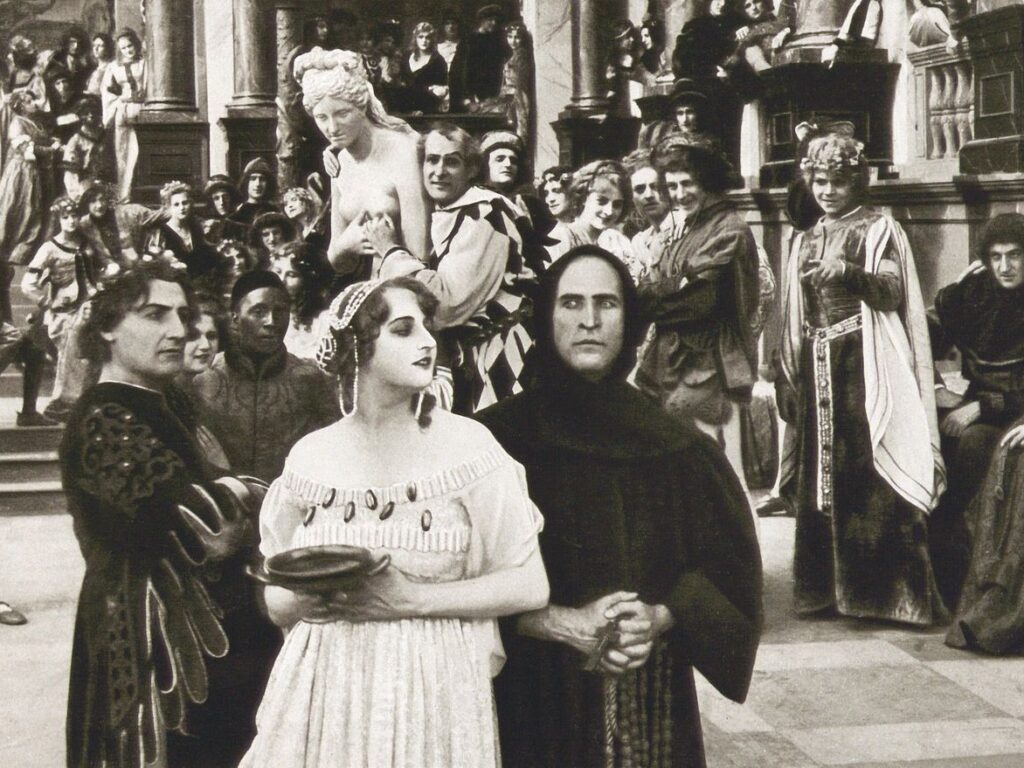
At 9:00 pm at Teatro Verdi, pride of place goes to Pest in Florenz (The Plague in Florence, 1919), directed by Otto Rippert with a screenplay by Fritz Lang. The film is included in the two-year retrospective “Weimar Uncensored, Taboos and Transgressions in German Cinema”, 1919-1920, dedicated to the short period following WWI, when Germany was in ruins, state censorship was absent and control was handed over to the local police. In a society traumatised by devastation and deep tensions, educational or “enlightenment films” on subjects such as sex gained ground, alongside more sensationalist works devoted to prostitution, drugs, alcoholism, madness and Satanism.
While many talents flourished during the period, such as Conrad Veidt, Anita Berber and Reinhold Schünzel, for decades, most productions were considered inferior compared to the major expressionistic masterpieces of the 1920s, like The Cabinet of Dr. Caligari, Nosferatu and Metropolis. Beyond artistic considerations, the interest of the films in the series, also for today’s audiences, lies in the unresolved dilemma between the demands of creative and often transgressive expression and damage to society at large. More generally, these films provided a record of the emotional state of a devastated society that, as in all times of uncertainty and crisis, needs a scapegoat, someone to blame for an unstable situation that is out of control. Pest in Florenz is a moral allegory with a dark vision of a civilisation nearing its end. Fritz Lang was 29 years old when he wrote the screenplay, and his experience of the war, during which he was wounded several times, was to mark his films forever.
The evening screenings close with Death Day (USA, 1934) by Sergei Eisenstein, made using material shot in Mexico for a project that was never completed by the great Soviet master. This is the third film based on that footage and is devoted to the Day of the Dead, when the fear of death is exorcised through a carnival-like atmosphere, to reaffirm the beauty and continuity of life. The new restored version presented at the festival is based on an almost complete 35mm nitrate copy purchased by the British Film Institute in 1939 and on a few seconds from a 16mm copy housed in the David Bradley Collection at the Moving Image Archive of the Indiana University Libraries.
The day at Teatro Verdi begins at 9:00 am with “Early Cinema” and M’liss (1918), one of Marshall Neilan’s finest films, starring Mary Pickford, written by Frances Marion and shot by Walter Stradling. Based on two stories by Bret Harte, the film is an unconventional western, peopled with eccentric characters and set in beautiful natural landscapes. Stradling’s cinematography in particular – he died prematurely after three more films with Neilan – was especially admired by the historian Kevin Brownlow.
At 10:30 am the festival once again features the art of the benshi with Taki no shiraito (The Water Magician, 1933) by Japanese master Kenji Mizoguchi, three-time winner of the Leone d’Argento (Silver Lion) at the Venice Film Festival, in 1952, 1953 and 1954. The film is reminiscent of the shimpa theatrical tradition, focussing on stories of women willing to sacrifice themselves for men of lower social classes or abilities. The screening will be narrated by benshi Kumiko Omori and accompanied by Makia Matsumura (piano), Kisayo Katada (percussion) and Nobuakira Kiyomoto (shamisen).
At 2:00 pm, the “Canon Revisited” series curated by Paolo Cherchi Usai will feature Zhizn Za Zhizn (A Life for a Life, 1916) by Yevgeni Bauer, based on the novel Serge Panine by Georges Ohnet. Bauer was considered the father of pre-revolutionary Russian cinema, directing over 80 films between 1913 and 1917, and applying his previous experience in the theatre, painting and set design.
At 3:15 pm, for the series on Greco-Roman Antiquities, the focus is on Bruto (1911) by Enrico Guazzoni, created before the famous Quo vadis and important because it marked Amleto Novelli’s debut as a leading man.
At 4:15 pm, the series on Spanish cinema presents Voluntad que vence (1919), starring Alba Tiberio, an extraordinary vaudeville star in the 1910s. Tiberio was a transformist, acrobat, sharpshooter, dancer, caricaturist, musician and athlete, already a star when she made her cinema debut. Musical accompaniment will be provided by Croscat-Ramblers with Aleix Cansell (piano), Giuseppe Campisi (bass), Enric Fuster (percussion), Nil Mujal (tenor sax and clarinet), Joan Mar Sauqué (trumpet) and Pablo Martín (trombone).
Finally, the annual lecture on costume design and silent cinema will be held at 5:45 pm at Teatro Verdi. This lecture series was created in 2022 by costume designer and historian Deborah Nadoolman Landis, director of the David C. Copley Center for Costume at the UCLA School of Theater, Film and Television. This year’s speaker will be costume designer and Academy Award winner for The Artist and Phantom Thread Mark Bridges. The conference, titled “The Artist (2011): A Recollection with Costume Designer Mark Bridges”, explores the creative process and the challenges of producing a low-budget silent film in black and white in the 21st century.
The Pordenone Silent Film Festival / Le Giornate del Cinema Muto is made possible thanks to the support of the Regione Autonoma Friuli Venezia Giulia, the Ministry of Culture – Direzione Generale Cinema, the city of Pordenone, the Pordenone-Udine Chamber of Commerce, the Fondazione Friuli and with the participation of BCC Pordenonese e Monsile.
Recent Comments